Multimodal Editing
Localized edits grounded in the page and its references.
 Co-Design Bench
A benchmark for multimodal coding agents
Multimodal Collaborative Coding Evaluation
for Agentic Models
Inside a real task
Watch an agent interpret a reference, edit an existing website, and check its work in the browser.
 qwen3.8-max-0902
The benchmark
Agents receive an existing application and a user’s request, sometimes with images, audio, video or documents. Hidden expert criteria check what changed, what works, and what should be preserved.
Localized edits grounded in the page and its references.
Coordinated changes across a multi-file application.
Can a coding agent turn a user’s multimodal request into a complete, working revision of an existing application?
Each task pairs a normalized request with a runnable pre-edit application and hidden, expert-authored acceptance criteria. Requests can carry image, audio, video or document evidence. The criteria specify the requested outcomes and any preservation constraints while permitting any valid implementation — so no gold code or target screenshot is needed.
Evaluating human–AI co-design requires testing whether coding agents can translate real users’ multimodal requests into working application revisions. We introduce Co-Design Bench, a reference-free benchmark of 273 tasks curated from 37,463 deduplicated queries across 26,314 real user coding sessions. Its two tracks, Multimodal Editing (ME) and Repository Editing (RE), cover localized edits with optional image, audio, video, or document inputs and coordinated repository revisions. Tasks span three capability dimensions: Grounded Understanding, UI Transformation, and Functional Implementation. The tasks pair normalized requests and runnable pre-edit applications with 2,331 hidden expert-authored acceptance criteria. Our judge-then-refute protocol grades criteria using source and browser evidence, challenges positive verdicts with a separate LLM verifier, and audits visual and interaction claims without gold code or target screenshots. Under a shared agentic harness, the strongest of ten model endpoints passes an average of 69.9% of criteria per task but fully satisfies only 26.4% of tasks. All ten endpoints achieve lower criterion completion on repository edits spanning three or four change types than on those spanning one or two. Co-Design Bench provides a testbed for studying the gap between partial requirement satisfaction and complete task success under agentic execution for real-user application revisions.
Localized visual, structural and content edits. The agent receives a runnable page, an annotated target region, a normalized request and optional image, audio, video or document attachments. Rubrics also check that unrelated content is preserved when requested.
Coordinated changes across components, routes, state, data flow and content in runnable multi-file frontend repositories. Experts decompose compound requests into separately auditable criteria, leaving implementation choices open.
How the tasks were built
Every starting application must build, launch and render before it becomes a task. Requests are deduplicated, filtered, ranked by difficulty, verifiability and historical failure signals, then consolidated into bounded tasks with hidden criteria (paper, Section 3.2 and Appendix I).
production queries across 26,314 real coding sessions, with their repositories, context and attachments.
Anchor each candidate to its target edit turn, then restore repository, assets and context with a source-hash snapshot.
task/
├─ baseline/
├─ env.manifest
├─ request + media/
└─ validation.log
unique queries after exact-hash and near-duplicate removal (token Jaccard > 0.8).
Decode attachments, rewrite pasted-image references, optional privacy screen.
Hard filters F1–F6 drop environment-blocked, non-actionable, unbounded and non-editing requests. Any hit → drop.
r = d + v + f
difficulty 0–5 · verifiability 0–3 · historical failure signal 0–2.
At most three queries per session become one bounded task; experts refine the request and write hidden criteria.
Co-Design BenchWhat the tasks test
Each task has one primary label for its main delivery objective; additional labels record its other required capabilities — 1,172 task–capability associations in all. 265 of 273 tasks carry multiple labels and 174 span more than one dimension.
How it compares
Existing web-coding benchmarks cover reference reconstruction, synthetic or predefined edits, version-history edits, and repository issues. Co-Design Bench combines real-user revisions, five input modalities, reference-free acceptance, agentic evaluation and adversarial verification (paper, Table 1).
Real-user sessions are requests from real-user coding histories, excluding standalone issue reports (DesignBench’s session requests belong to its editing subset). Reference-free acceptance needs no gold code or target screenshot; a pre-edit baseline is allowed. Agentic evaluation actively chooses tools and actions, beyond fixed test replay. Adversarial verification separately challenges initial positive verdicts. Definitions follow the paper’s Table 1.
Ten models. One shared harness. All 273 tasks.
Mean criteria passed per task.
Only one in four tasks fully delivered.
Strict-completion gap: 3–4 vs. 1–2 edit types.
Strict completionPer task, the fraction of criteria judged PASS; averaged over tasks with equal weight so long rubrics do not dominate. PARTIAL earns no strict credit.
Graded completionSame average with PARTIAL worth 0.5. On a normalized scale, Full-pass ≤ Strict ≤ Graded.
Full-pass ratePercentage of tasks where every criterion is PASS — complete delivery. The gap to Strict is criterion credit from unfinished tasks.
Turns · Len.Median solver turns per task, and mean output tokens per turn.
TokensTotal token traffic per task in millions, including retries and reported cache usage under each API’s accounting; an execution measure, not a monetary cost.
Tool mixShare of tool calls for execution (Bash), inspection (Read / Grep / Glob) and modification (Edit / Write); the remainder is auxiliary.
Rankings move
Strict-completion rank on ME (left) and RE (right). Rankings correlate (Spearman ρ = 0.818), yet qwen3.8-27b climbs from fifth to second while kimi-k3 drops from fourth to sixth.
Endpoint means span 28.7 points on ME and 13.0 on RE; a combined ranking can conceal setting-specific strengths.
The delivery gap
Strict completion versus full-pass rate across all 273 tasks. The distance between the two is criterion credit earned on tasks that still miss at least one requirement.
Look beyond the average
Pick a capability, an attachment modality or an edit breadth to compare all ten endpoints.
Effort is not completion
gpt-6-astra, ME strict 75.4%glm-5.2, ME strict 57.2%On RE, qwen3.8-27b uses 57 turns and 6.72M tokens for 64.5% strict completion, versus 48 turns and 2.33M tokens for gpt-6-astra at 66.7%.
Media in the loop
ffmpeg also appears in 25.0% of audio runs and faster-whisper in 4.4%. Some agents download and run pretrained perception models — AST, CLAP, Whisper, Qwen2-Audio, CLIP, DINOv2, OWLv2 — to ground their edits.
Execution profiles
Image inspections average 14.47 per run on ME and 2.78 on RE, while the Edit/Write share of tool calls rises from 7.3% to 27.6%. These profiles describe effort; they do not isolate causal effects.
Why another benchmark
On the same 150 WebCompass-edit tasks, switching qwen3.7-plus from single-shot to agentic execution raises mean graded feature completion from 73.6% to 95.1%, with the feature rubric, judge and render pipeline held fixed. With agentic execution, opus-4-8 reaches 99.4%.
Co-Design Bench evaluates real users’ compound revisions under iterative tool access, and reports both criterion satisfaction and complete task success.
The cross-benchmark bars use different task pools and evaluation protocols; the paired WebCompass comparison concerns execution within a fixed task set (paper, Appendix A).
opus-4-8’s graded completion over all tasks in Table 5 (0.649).Open a task to inspect its inputs, model output and acceptance criteria.
A six-second reference clip shows three different text animations. The agent must map them to the hero, section title and quotation, loop each effect, and preserve the wording and page layout. This timeline follows the archived qwen3.8-max-0902 run, including the frames and screenshots the model actually looked at.
qwen3.8-max-0902 passes all six hidden criteria: 100% strict completion in the frozen paper run.
The timeline shows selected steps; the counts include every call in the archived run.
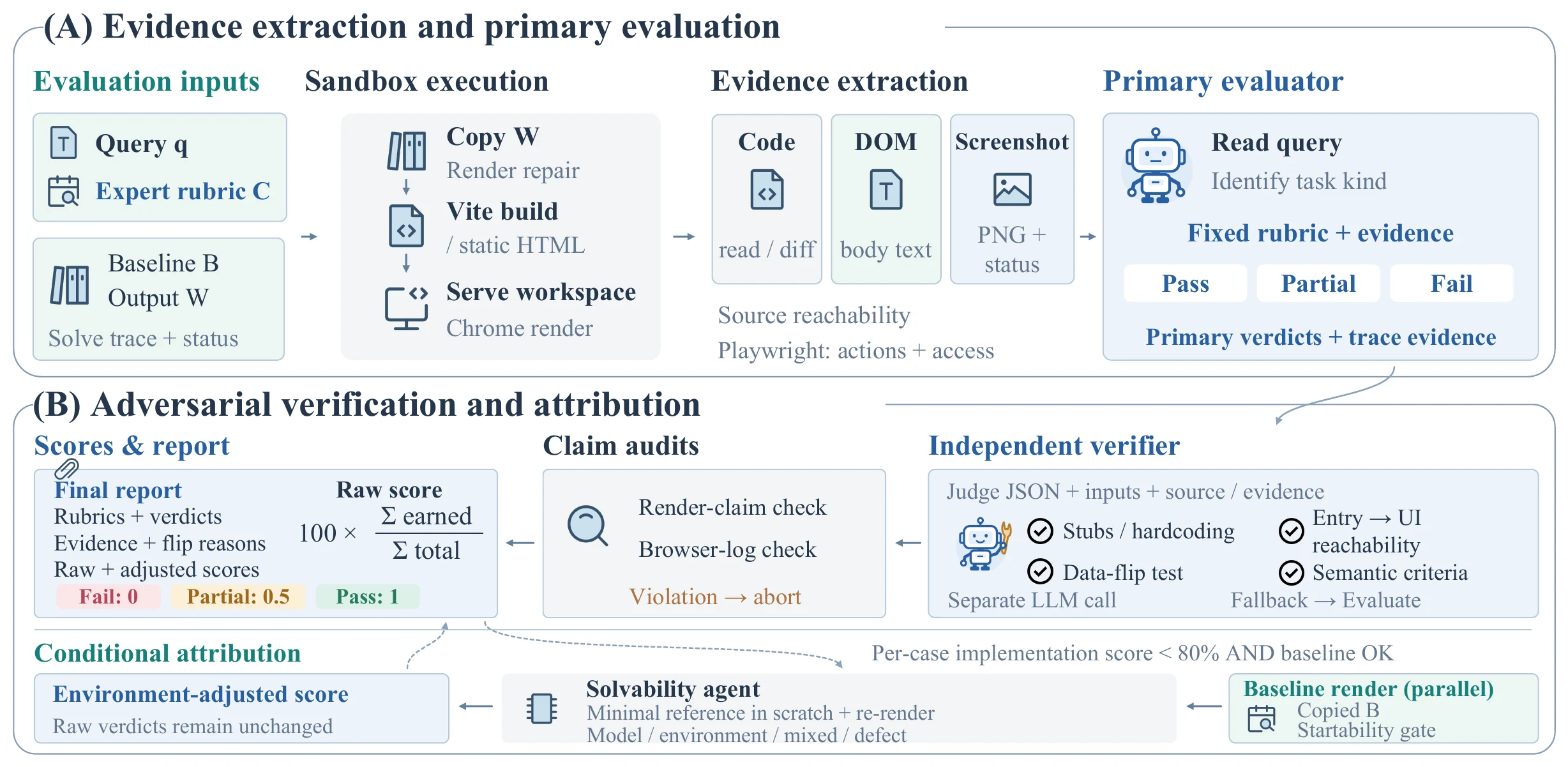
Test the application, then challenge every positive verdict.
Build and launch the final application in an isolated sandbox.
Inspect source, screenshots and browser interactions for each requirement.
Grade each hidden criterion PASS, PARTIAL or FAIL against the starting app.
A separate verifier challenges credit for stubs, hardcoding and unreachable features.
Rt = # PASSnt
fully satisfied criteria in task tGt = # PASS + ½ # PARTIALnt
credits partial progressF = share of tasks with Rt = 1
every criterion deliveredTask means weight all 273 tasks equally, so long rubrics do not dominate. On a common 0–1 scale F ≤ R̄ ≤ Ḡ, and a high R̄ can coexist with a low F when unmet requirements are spread across many tasks.